

Productivity, is actually the Holy Grail and the main focus point of the modern economy, the standard for measuring our worth and our workload. For many decades, we have simply accepted the 40 hours equation that implies: 40 hours of presence is equal to maximum level of output. But what if this long held foundational belief is a lie? Also what if the relentless insistence of 40-hour is not intended to gain the maximum and obtain the peak level of productivity but for something that is entirely different? The data from global experiments on the four-day workweek has interestingly suggested that we have been misled and lied to, and the real issue may be about some level of control.
The Burnout Culture of the 40-Hour Grind

The normal 5-days a week model is simply an old concept that belong to the past age and its unsuitability now is in the form of widespread burnout. Most employees are physically present but mostly mentally depleted resulting in mental absent. This model seem to prioritize seat time over strategic thinking, confusing long hours with high performance, thus resulting in a culture of exhaustion where productivity rise fairly and declines sharply. This is not just sustainable; it infect fast tracks high levels of disengagement and turnover. This system helps in fueling fueling the very problem it claims to solve.
The Data Speaks differently: 20% More Productive
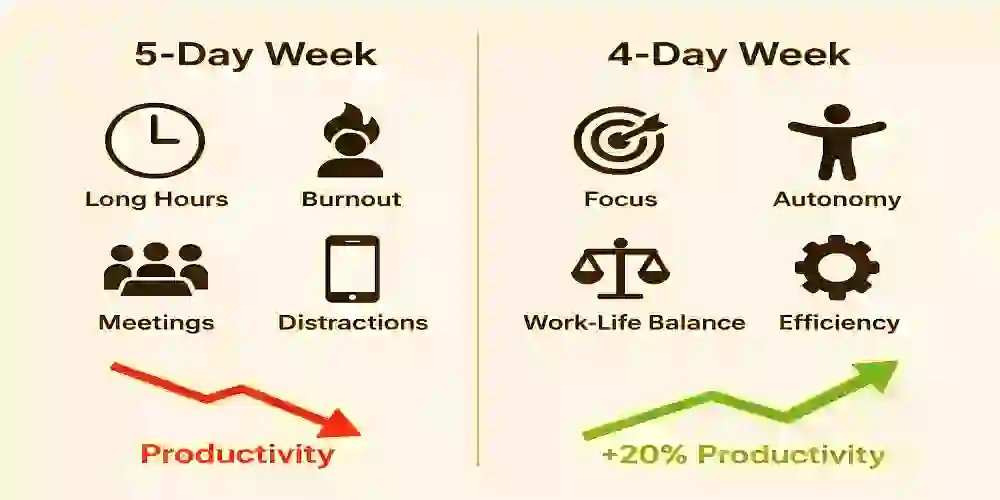
Let us now consider the evidence. Pilot trials in countries like Iceland and the UK, together with other numerous company-specific case studies, have delivered a significant and stunning verdict. These trials shows that companies that shifted to a four-day week, with no reduction in pay, reported an increase in productivity. The result indicted that employees were about 20% more productive. How? The abridged week forced the elimination of inefficiencies— like useless meetings, constant context-switching, and digital distractions. When workers, are gifted with reasonable and restored work-life balance and some level of autonomy, returned to work more focused, energized, and motivated. This data proves that when you measure output instead of hours, productivity rises.
Is the 40-hour week Really About Productivity, or About Control?
If as seen above the data seems compelling, then we will be forced to ask the uncomfortable question: why is there such a resistance? The answer may lie in a shift from output to obedience. The 40-hour week, with its extreme demand for physical presence, is a powerful tool for control. It also represents a visual and cultural symbol of authority. In this kind of environment, micromanagement thrives in this environment. Moving to a results-only work environment (ROWE) or a four-day week requires managers to trust their employees and measure what actually matters: completed work. This transfer of control from the employer to the employee is a radical departure from corporate norms that many traditional structures are unwilling to make.
Productivity isn’t the victim of the four-day workweek; it’s the beneficiary. The real obstacle is a deep-seated culture of control that mistakes visibility for value. The question is no longer if a shorter week boosts output, but whether companies are brave enough to relinquish control and finally start trusting their people to get the job done.